


Best Paddles for Soft Game Control and Resets

A paddle can look great during a full-speed drive exchange and still let you down on the shot that matters most: the defensive reset that has to clear the net by inches and land harmlessly in the kitchen. The best paddles for soft game performance are not simply the softest-feeling paddles on the market. They give you enough dwell time to shape the ball, enough stability to absorb pace, and enough consistency across the face that an off-center dink does not turn into a pop-up.
For players trying to win more points at the kitchen line, that combination matters far more than flashy claims or inflated price tags. Here is how to identify the paddle characteristics that actually support better dinks, drops, resets, and counters - plus the Kiwi Labs models that fit different types of soft-game players.
Why soft-game control is more than a low-power rating
A soft game is about managing energy, not eliminating it. On a third-shot drop, you want the ball to come off the face predictably. On a reset, you need the paddle to absorb an opponent's drive without twisting or launching the ball too high. During a dink exchange, you want enough touch to change height, depth, and spin without feeling like every ball is stuck on the face.
That means a paddle labeled “control” is not automatically the right answer. An overly muted paddle can make it harder to punch a dink deep or counter a speed-up. A very powerful paddle can still work beautifully at the kitchen if its face is stable and its response is predictable. The goal is controlled response: a paddle that lets your hands make the decisions.
What makes the best paddles for soft game players
Dwell time creates usable touch
Dwell time is the brief moment the ball stays connected to the paddle face. More perceived dwell gives players a clearer sense of the ball and more opportunity to guide it. That is especially useful when you are rolling a crosscourt dink, carving an angled drop, or taking pace off a hard body shot.
Raw carbon fiber faces are popular for this reason. Their texture also helps create spin, which lets you swing with confidence while keeping a dink or drop inside the lines. But face material is only one piece of the equation. The core, paddle construction, and overall balance determine whether that textured face feels controlled in live play.
A large, stable sweet spot protects imperfect contact
Nobody contacts every dink in the exact center of the paddle. The real test comes when you are stretched wide, hand-fighting at the kitchen, or trying to reset a ball that caught you late. A forgiving sweet spot keeps those contacts from dying short, drifting wide, or bouncing up into an easy attack.
Stability is just as valuable. A paddle that resists twisting through contact lets you hold your line on blocks and defensive resets. Players often chase softness when what they really need is a more stable face. If the paddle wobbles in your hand, even a gentle touch can produce an unpredictable result.
Shape and balance affect your hands
Standard and hybrid-shaped paddles generally put more usable face area in front of your hand, which can make kitchen exchanges feel calmer and more forgiving. Elongated shapes can offer additional reach and leverage, but they may feel less maneuverable or have a narrower sweet spot depending on the build.
Balance matters, too. A head-heavy paddle can add put-away power and serve depth, but it may slow down your hands in a fast firefight. A more balanced setup often makes it easier to reset, reload, and disguise a dink. There is no universal winner here. A player who attacks from the baseline may accept a little extra swing weight, while a dedicated doubles player may prioritize quick handling.
Kiwi Labs paddles for different soft-game needs
The right soft-game paddle depends on whether you need more forgiveness, more spin, or more ability to turn a neutral ball into an offensive one. Kiwi Labs builds each of these profiles with premium materials and modern construction, without asking players to pay legacy-brand pricing for the logo.
DwellPop Gen 4 for connected touch with offensive options
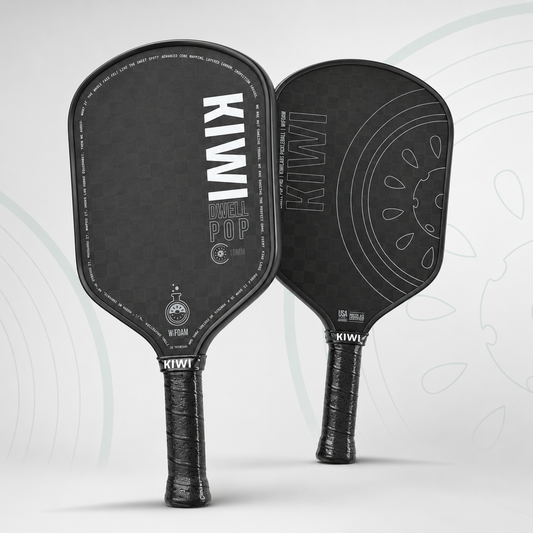
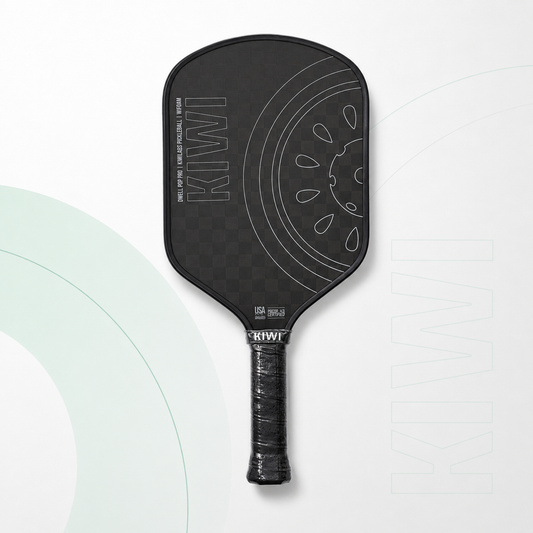
The DwellPop Gen 4 is the choice for players who want a more connected feel on soft shots but refuse to give up the ability to finish points. Its full-foam design is built around dwell time and pop, an appealing combination for intermediate and advanced players who want to absorb pace at the kitchen and still accelerate through a counter when the opening appears.
This is a strong fit if your current paddle feels too springy on resets or too dead when it is time to attack. The trade-off is that a more responsive paddle asks for clean hands. Spend a few sessions calibrating your grip pressure and reset stroke before judging it solely on a warm-up dink line.
Slice 1.5 for spin-heavy all-court control
The Slice 1.5 pairs thermoformed construction with a raw carbon face, making it a smart option for players who want their soft game to create pressure rather than merely survive exchanges. The raw carbon surface supports shaped dinks, dipping drops, and roll volleys that pull opponents out of position.
Choose this profile if you like to vary your kitchen game. You can send a neutral ball crosscourt, then use the same setup to add a little more topspin or angle. Thermoformed construction can bring a firmer, more lively response than a purely plush control paddle, so players who prefer an ultra-muted feel should focus first on touch and stability during their trial sessions.
Circuit for the player building an all-court game
The Circuit suits the improving player who needs one paddle to handle practice drills, rec play, and more competitive games. All-court players benefit from a platform that does not force a hard choice between soft touch and enough pace for serves, returns, and counters.
For a player moving beyond beginner equipment, that balance can be more useful than buying a highly specialized paddle too early. Better soft-game results often come from a predictable paddle you will trust on every ball, not a control-only model that leaves your drives and counters underpowered.
Citrus 2.0 for confidence-building touch
Newer players should not assume they need the most advanced construction to improve their kitchen game. The Citrus 2.0 is a beginner-friendly path for players who need to develop feel, contact consistency, and confidence without making the learning process more complicated.
A forgiving paddle is valuable while you are learning to soften your grip, use your legs on drops, and keep the paddle in front on resets. As your hands get faster and your shot selection improves, you can decide whether your game needs more spin, more pop, or a more specialized feel.
How to test a paddle for soft-game performance
Do not judge a paddle only by hitting a few hard serves. Give it a kitchen-line test with real movement and pressure. Start with crosscourt dinks and notice whether you can land the ball near the opponent's feet without forcing your stroke. Then hit straight-on dinks, where the net is higher and control is less forgiving.
Next, ask a partner to drive balls at your torso and both shoulders. Focus on compact resets, not aggressive blocks. Does the paddle stay stable when contact misses the center? Can you deaden pace without the ball sitting up? Those answers reveal more about soft-game value than a spec sheet ever will.
Finally, test transition drops and counters. The best paddle for your game should let you shift from soft to firm without a major change in timing. If you have to baby every dink or overswing every counter, the response may not match your natural stroke.
Do not let a paddle replace soft-game fundamentals
Even the best face and core cannot fix a death grip or rushed footwork. Keep your grip pressure light during dinks and resets, meet the ball out in front, and use your legs to control height rather than flicking with your wrist. On defense, aim for a simple target over the middle of the net instead of trying to hit a perfect winner from a bad position.
A great paddle should make those sound choices easier. Pick the one that gives you confidence to take pace off when the point demands patience, then trust your hands when the next ball gives you permission to attack.