


How to Improve Kitchen Touch in Pickleball

A tight match can turn on one soft ball. Your opponent speeds up a dink, you get your paddle on it, and the reset floats just high enough to get crushed. That is the kitchen game in a sentence. Learning how to improve kitchen touch is not about making every ball softer. It is about controlling height, depth, shape, and pace when the court gives you almost no room for error.
Great kitchen touch lets you absorb hard balls, keep dinks unattackable, take speedups out of the air, and create openings without forcing low-percentage shots. It comes from clean mechanics, better decision-making, and a paddle that gives you feedback instead of launching the ball unpredictably.
Start With a Softer Grip, Not a Softer Swing
Most players lose touch because they squeeze the handle too hard. A death grip turns your paddle into a rigid wall. Even a medium-paced ball rebounds too far, especially on volleys and resets near the non-volley zone line.
Think of your grip pressure on a scale of 1 to 10. For dinks and resets, live around a 3 or 4. Your hand should feel connected to the handle, but your fingers and wrist should not be locked. You can firm up briefly when you counter a fast ball, then relax again as the point returns to a soft exchange.
This does not mean letting the paddle flop around. The paddle face still needs to be stable through contact. The goal is controlled softness: a quiet hand, a compact stroke, and enough structure in your wrist to send the ball where you intend.
If your dinks keep popping up, first check your grip before changing your entire swing. Players often try to guide the ball with a bigger follow-through when the real issue is that their hand is adding too much rebound.
Improve Kitchen Touch With Better Contact Position
At the kitchen line, the ball changes fast. Contacting it late forces you to flick, scoop, or reach across your body. Those emergency motions make soft shots much harder to control.
Your best contact point is generally in front of your body, around waist to chest height for volleys and lower for dinks. Keep your paddle out in front with the face slightly open when lifting a low ball. When the ball is above net height, a more neutral or slightly closed face helps prevent it from sailing.
The key is to move your feet before your hands. If a dink pulls you wide, shuffle and arrive balanced rather than stretching your arm toward the ball. A balanced player can use a short, repeatable stroke. A reaching player has to improvise.
That is why kitchen touch is as much a footwork skill as a hand skill. Small adjustment steps may not look dramatic, but they keep your shoulders level and your paddle face consistent. At the line, consistency beats highlights.
Keep the Paddle Path Compact
Long backswings are useful when you need pace from the baseline. They are a liability in the kitchen. A compact paddle path gives you less timing to manage and fewer chances to open or close the face by accident.
For a dink, let the shoulder and forearm make a small lift through the ball. Avoid snapping the wrist upward. For a reset, use an even shorter motion. Meet the incoming ball, soften your grip, and let its pace do much of the work. Your objective is not to win the reset. It is to put the ball back into the kitchen and buy your team time to get neutral again.
Stop Trying to Hit Every Dink Perfectly
A quality dink is not always a ball that lands inches from the sideline. It is a ball that keeps your opponent from attacking comfortably.
The safest target for many exchanges is crosscourt, where you have more court length and a lower net in the middle. A crosscourt dink with enough arc and depth gives you a larger margin than a sharp, low-percentage angle. Once you can repeat that ball, you can add pressure by changing the depth, using a little topspin, or pulling an opponent wider.
Down-the-line dinks have value, but they demand more precision. Use them when the opponent has drifted too far toward the middle, when their paddle is late, or when you can keep the ball low. If you are struggling with touch, do not use the line as your default proving ground.
The same principle applies to resets. A reset that lands safely in the middle kitchen is often better than a fancy angled reset that clips the net or sits up. Smart touch is purposeful, not flashy.
Train Your Hands to Absorb Pace
Soft hands are built through repetition against real pace. You need to practice receiving balls that are faster than a cooperative dink, because that is when tension tends to take over.
Try these four drills during your next session:
- Crosscourt dink ladder: Start by landing five dinks in a row inside the kitchen. Then aim for 10, then 15. If the ball goes high or deep, restart. This develops patience and exposes rushed mechanics.
- Reset-from-transition drill: Have a partner drive balls at your feet as you move from midcourt toward the kitchen. Focus only on dropping each ball into the kitchen. Do not counterattack until you can control the reset.
- Volley absorb drill: Stand at the kitchen line while a partner sends controlled speedups at your torso and paddle side. Block them back softly with minimal swing. Alternate forehand and backhand.
- Dink-to-speedup drill: Dink cooperatively until one player chooses a safe speedup. The other player must either counter with control or reset the ball into the kitchen. This teaches you to recognize when touch, not power, is the right answer.
Use Spin to Create Margin, Not Just Style
Topspin can be a major touch tool when used correctly. A gentle low-to-high brush lets the ball arc over the net and dip into the kitchen, which can make your dinks safer and harder to attack. Backspin can keep a short ball low, but it requires a cleaner contact point and can float if you cut underneath too aggressively.
You do not need to put heavy spin on every dink. In fact, chasing maximum spin can pull your paddle face out of position. Start by developing one dependable topspin dink from each side. Use enough brush to shape the ball, while keeping the stroke compact and the target simple.
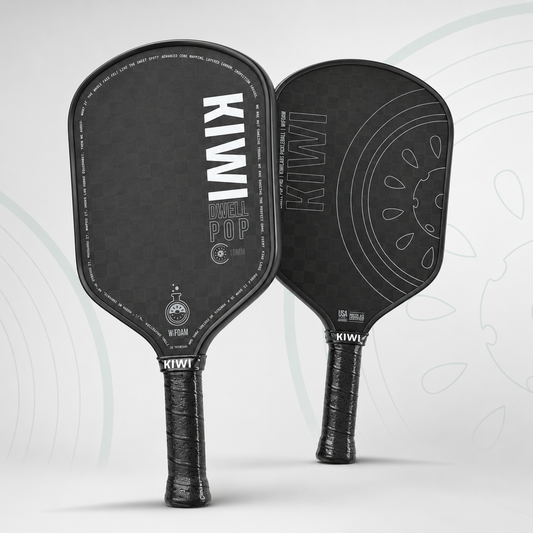
Paddle surface matters here. A quality raw carbon fiber face can help you generate spin with less exaggerated motion, while a larger sweet spot can make off-center kitchen contact less punishing. Those features do not replace technique, but they can make the learning process more predictable. That is one reason Kiwi Labs builds paddles around controllable dwell time, spin-friendly faces, and usable all-court feel rather than inflated claims alone.
Know When to Reset and When to Counter
Kitchen touch improves quickly when you stop treating every fast ball as an attack opportunity. If the ball is below net height, at your feet, or pulling you off balance, reset it. Trying to fire back from a poor position usually gives your opponents the next easy put-away.
Counter when the ball is above net height and in front of you, especially if your paddle is set early. Keep the counter compact and aim through the middle or at the opponent's dominant hip. You do not need a huge swing to make a speedup effective.
The strongest players can switch from soft to firm without telegraphing either choice. Their hands stay calm, their paddle starts in front, and they read the ball early. That is the standard to work toward.
Build Touch Into Your Game Before Every Match
Spend the first five minutes of warmup on touch, not power. Hit crosscourt dinks, practice a few soft volleys, and reset balls from the transition zone. Pay attention to grip pressure and contact point before you start driving serves or ripping overheads.
Kitchen touch is earned through thousands of quiet, intentional reps. Keep your grip relaxed, your paddle path short, your feet active, and your targets realistic. When the next speedup comes at your chest and you can calmly drop it back into the kitchen, you will feel exactly why the soft game wins so many hard points.