


A Guide to Paddle Twistweight and Better Control

A mishit near the edge of your paddle should not feel like the paddle is trying to escape your hand. That is the real-world reason to care about this guide to paddle twistweight. While swingweight gets most of the attention, twistweight is a major reason one paddle feels planted and forgiving while another feels quick but gets pushed around on off-center contact.
For players working on cleaner drops, more reliable resets, and confident counters at the kitchen line, twistweight is not a spec to ignore. It helps explain whether a paddle keeps its face stable when the ball catches closer to the edge than the center - which happens far more often in actual points than it does in a perfect paddle test.
What Is Paddle Twistweight?
Twistweight measures a paddle's resistance to twisting around its long axis when you strike the ball away from the center of the face. Think of a volley that catches high toward the outer edge, or a fast drive that clips the side of the paddle. The ball applies force away from the centerline, creating torque that wants to rotate the paddle face open or closed.
A higher twistweight means the paddle resists that rotation more effectively. The result is a more stable feel, less flutter in your hand, and a better chance that your shot still travels where you intended. A lower twistweight allows more rotation on those same misses. That can make the paddle feel less forgiving, especially against pace.
Do not confuse twistweight with static weight. Static weight is what the paddle weighs on a scale. Swingweight is how heavy it feels when you accelerate it through the ball. Twistweight is about stability when contact moves side to side across the face. They influence one another, but they are not interchangeable.
Why Twistweight Changes Your Game
Pickleball is full of imperfect contact. You reach for a body shot, react to a speed-up, stretch wide for a dink, or get jammed on a return. In each situation, a stable paddle can shrink the penalty for missing the exact middle of the sweet spot.
More forgiveness on off-center shots
High twistweight helps preserve the paddle face angle when you catch the ball toward the perimeter. Your reset is less likely to float. Your block is less likely to spray wide. Your volley has a better chance of staying deep rather than dying short because the paddle twisted at impact.
This does not turn edge contact into clean center contact. A mishit still loses some energy and feel. But a well-designed, stable paddle makes the miss more playable, which is exactly what many recreational and competitive players need during fast exchanges.
A more stable kitchen-line paddle
At the non-volley zone, reaction time is short and opponents are often targeting your hips, shoulders, and paddle-side elbow. You do not always get to set your feet and find the sweet spot. High twistweight gives your hand a steadier platform for counters, blocks, and defensive punch volleys.
That stability is particularly noticeable when absorbing pace. Instead of feeling the face get knocked back or pulled sideways, the paddle holds its line more consistently. Players often describe this as a solid, connected, or planted response.
Better confidence under pressure
The benefit is not only physical. When your paddle is predictable across more of the face, you can commit to your shot. That matters on a backhand counter, a wide forehand roll, or a last-second reset when tentative contact usually creates the mistake.
A large effective sweet spot and strong torsional stability give you more usable face area. That does not replace footwork or technique, but it gives developing players more margin while their technique catches up to the speed of the game.
What Creates Higher Twistweight?
Paddle shape, width, construction, weighting, and handle design all affect how a paddle resists twisting. There is no single magic material that guarantees a high twistweight. Smart construction is what makes the difference.
A wider paddle face generally has more material positioned farther from the centerline, which can improve torsional stability. That is one reason standard and hybrid shapes often feel more forgiving than narrow, elongated paddles. The trade-off is that elongated designs can offer extra reach and may feel faster through a compact swing, depending on the overall build.
Perimeter weighting can also raise twistweight. Mass placed toward the sides of the paddle makes it harder to rotate on off-center impact. Foam-injected edges, perimeter foam, and carefully engineered edge construction can all contribute to a more stable response without simply making the entire paddle excessively heavy.
Face and core construction matter as well. A quality carbon fiber face paired with a well-tuned polymer or foam core can help the paddle feel more unified at contact. The goal is not just a big number on a spec sheet. It is a face that remains predictable when you hit hard, soft, centered, or slightly late.
Twistweight vs. Swingweight: The Trade-Off Players Need to Know
Higher twistweight is usually a good thing for stability, but more is not automatically better for every player. Added stability often comes from adding or positioning mass, and that can affect swingweight. If a paddle becomes too head-heavy for your hands and mechanics, quick exchanges may feel slower even if the paddle is exceptionally stable.
This is where player preference matters. A player who lives at the kitchen line and battles hard hitters may gladly accept a slightly more substantial feel for better blocking and countering. A player who relies on fast hand battles, aggressive rolls, and rapid grip changes may prefer a lighter, quicker setup, even if it gives up a bit of off-center forgiveness.
The best paddle is not the one with the highest twistweight in isolation. It is the one that gives you enough stability without taking away the hand speed, touch, and maneuverability your game depends on.
How to Choose the Right Twistweight for Your Game
Start with the shots that fail under pressure. If your paddle twists on defensive blocks, if wide volleys wobble, or if balls hit near the edge die unexpectedly, prioritize stability. Look for a paddle with a wider or hybrid profile, a generous sweet spot, and construction designed to reinforce the perimeter.
If your main issue is slow hands, first check whether your current paddle's swingweight is too demanding. You may need a more balanced option rather than simply chasing maximum stability. A paddle can be stable without feeling like a hammer, but the balance point and total build need to work together.
For most improving all-court players, a medium-to-high twistweight is a smart target. It provides useful forgiveness for resets, blocks, and stretched volleys while still supporting controlled acceleration on serves, drives, and speed-ups. Players who want an advanced construction with a stable, connected feel should compare the full package: shape, swingweight, sweet spot, core feel, and surface performance.
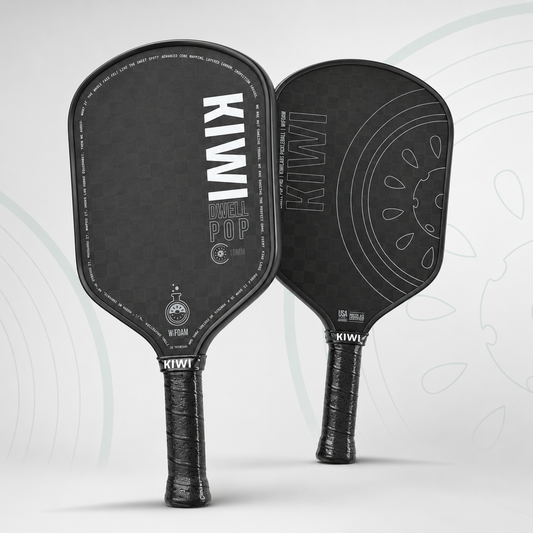
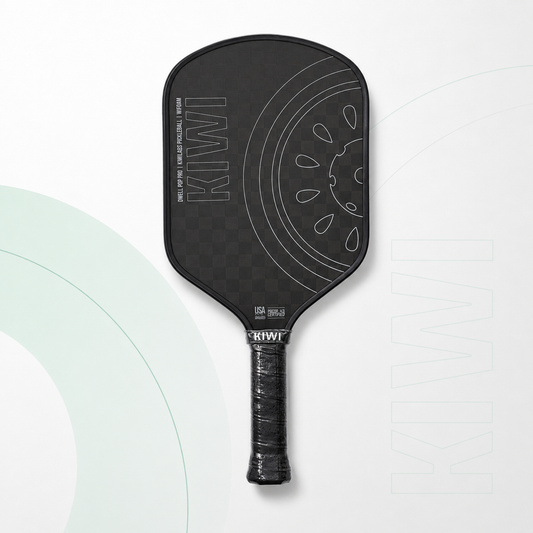
Kiwi Labs Pickleball builds its paddles around that practical equation - modern materials and large usable sweet spots, not inflated pricing or specs that sound impressive but fail to help during a real hands battle.
Can You Add Twistweight With Lead Tape?
Yes. Adding weighted tape near the 3 o'clock and 9 o'clock positions can increase twistweight because it places mass out toward the sides of the paddle. For players who love their current paddle's feel but want more stability on off-center shots, this is a useful experiment.
Start small. Even a few grams can noticeably change the response, especially on a lighter paddle. Add equal amounts on both sides, test it during dinks, resets, counters, and serves, then adjust from there. Tape too high on the face can make the paddle feel more head-heavy and can increase swingweight faster than you expect.
Weight near the throat tends to produce a subtler stability change with less impact on hand speed. Weight farther toward the upper corners can create a more dramatic stability boost but may slow the paddle in quick exchanges. There is no universal placement because hand strength, grip style, paddle shape, and playing role all matter.
Test Twistweight Where It Counts
Do not judge paddle stability from casual warm-up alone. Test it against pace. Have a partner hit firm volleys at your body, feed balls wide of your strike zone, and challenge your backhand block. Notice whether the paddle face stays quiet when contact drifts toward the edge.
Then test the other side of the trade-off. Can you still reload quickly for the next counter? Can you disguise a roll volley, react to a speed-up, and control a soft dink without feeling like the head is lagging behind your hand? A paddle that feels great on one clean drive is not necessarily the best match for a full match.
The right amount of twistweight gives your paddle a calmer, more reliable response when the point gets messy. That is where better equipment earns its place: not by rescuing every bad swing, but by keeping more of your almost-perfect shots in play.