


How to Improve Reset Consistency in Pickleball

A reset that sits up is an invitation to get attacked again. A reset that lands softly in the kitchen turns a losing exchange into a neutral one. That is why learning how to improve reset consistency is one of the fastest ways to become tougher to beat in pickleball, especially when you are caught in the transition zone against players who can speed up the ball.
The goal is not to hit a pretty winner from below net height. The goal is to absorb pace, reduce the ball's forward energy, and place it in a spot that prevents your opponent from taking another aggressive swing. Consistent resets are built with positioning, compact mechanics, and a paddle that gives you enough touch to trust a softer response under pressure.
What a Good Reset Is Actually Designed to Do
A reset is a defensive soft shot, usually hit from the transition zone, that drops into the non-volley zone and buys you time to move forward. It commonly follows a drive, a roll volley, or a speed-up that forces you to contact the ball below net height.
The best reset does not need to die perfectly over the net every time. It needs to be low, unattackable, and predictable enough that you can take your next step toward the kitchen. A ball that lands near the opponent's kitchen line can work well if it stays low. A ball that lands too deep, floats high, or carries too much pace keeps you pinned in no-person's-land.
There is a trade-off: aiming too close to the net creates errors, while aiming too deep gives away a more attackable ball. For most players, the highest-percentage target is the middle third of the kitchen. That gives you margin without feeding an easy speed-up.
Start With Your Feet, Not Your Hands
Many players blame their paddle when resets spray long or pop up. Often, the real issue happened a step earlier. If you are moving fast through the ball, reaching sideways, or contacting it behind your hip, your hands are forced to make a last-second save.
As you move through the transition zone, use short, balanced steps. Split step as the opponent contacts the ball, then take one controlled step into your reset. This lets your body arrive under control instead of falling backward or drifting through contact.
Your base should feel athletic but quiet. Keep your chest over your toes, knees flexed, and weight slightly forward. If you lean back, the paddle face naturally opens and sends the ball high. If you lunge too far forward, you tend to jab at the ball and add unwanted pace.
The hard truth is that some balls are not realistically resettable with one smooth drop. When you are stretched wide, late, or facing a shoulder-high attack, a compact block to the middle may be the smarter play. Better decision-making is part of reset consistency. Do not demand a perfect kitchen reset from a ball that calls for survival.
Keep the Paddle Out Front and the Swing Compact
A consistent reset starts from a ready position with the paddle in front of your body, around chest height. The farther your paddle drifts back, the more likely you are to swing instead of absorb.
Think of the reset as a catch-and-guide motion. Your paddle path should be short, with very little backswing and follow-through. Let the incoming ball provide most of the energy. Your job is to soften its exit, not manufacture a shot.
For balls near your dominant-side hip, use a compact forehand with a stable wrist and a slightly open face. For balls near your non-dominant-side hip, the two-handed backhand reset can offer extra stability, particularly against heavy pace. Players with a reliable one-handed backhand can use it effectively too, but the paddle face must stay quiet through contact.
Avoid flipping your wrist upward to lift the ball. That move creates pop-ups because it adds loft at the exact moment you need control. Instead, slightly open the paddle face before the ball arrives, then let your legs provide a small upward lift. The hand stays soft, but the wrist stays structurally stable.
Soften Your Grip Without Making It Loose
“Soft hands” is helpful advice, but it gets misunderstood. You do not want a floppy paddle. You want a relaxed grip that can absorb pace while keeping the face stable.
On a 1-to-10 grip-pressure scale, most resets live around a 3 or 4. Tighten only enough to stop the paddle from twisting at contact. Against a very hard drive, you may need to move closer to a 5, but squeezing at an 8 or 9 usually turns a reset into a punch volley.
Try this feel: hold the paddle as if you need to keep it secure while catching a water balloon. Too loose and it falls. Too tight and it bursts. That controlled softness helps the ball spend a fraction longer on the face, giving you a more predictable launch and better touch.
Choose Targets That Protect You
Crosscourt resets give you more kitchen to work with, which makes them a great default when you have time and space. The longer diagonal path also helps the ball lose pace before it reaches your opponent.
But crosscourt is not always the safest answer. If your opponent is crowding the middle or has a strong attacking backhand, a reset toward their outside foot may be better. When you are under heavy pressure, the center is often the smartest target. It creates communication questions for the other team and keeps your ball away from both players' sharpest angles.
Do not chase sidelines with a reset. You are trying to get out of trouble, not paint a line. A safe ball to the kitchen middle is usually more valuable than an ambitious ball that misses by inches.
Train Resets at the Speed You See in Games
Hand-feeding gentle balls can teach the basic feel, but it will not prepare you for a real drive at your feet. Build up your training in layers.
Start with a partner at the kitchen line and stand near the transition zone. Have them send controlled volleys to your forehand and backhand while you reset into the kitchen. Focus on height first: clear the net by a safe margin and make the ball land short. Once you can place eight out of 10 balls, add movement.
Next, have your partner drive from the baseline or transition zone while you work your way forward. Your only job is to reset, take one balanced step, and reset again if needed. This drill teaches the real sequence: defend, recover, advance.
Finally, play a constrained game. Start each rally with one team in the transition zone and award a bonus point when that team reaches the kitchen without popping up a ball. Constraints force repetition, and repetition under a scoring consequence reveals whether your technique holds up.
Video helps here. Watch whether your paddle starts out front, whether your contact happens beside your body, and whether your feet stop before impact. The answer is often obvious on film, even when it felt fine during play.
Your Paddle Can Help, but It Cannot Replace Technique
A large, forgiving sweet spot and a control-oriented feel make resets easier to repeat, especially on off-center contact. Raw carbon fiber faces can also help players add useful spin to certain reset variations, while a stable construction resists twisting when a hard ball catches the edge of the paddle.
Still, more pop is not automatically better for this shot. A powerful paddle can be excellent for counters and drives, but it may require cleaner hands on delicate transition resets. Players who struggle with balls sailing long should prioritize predictable response and dwell time over chasing maximum power.
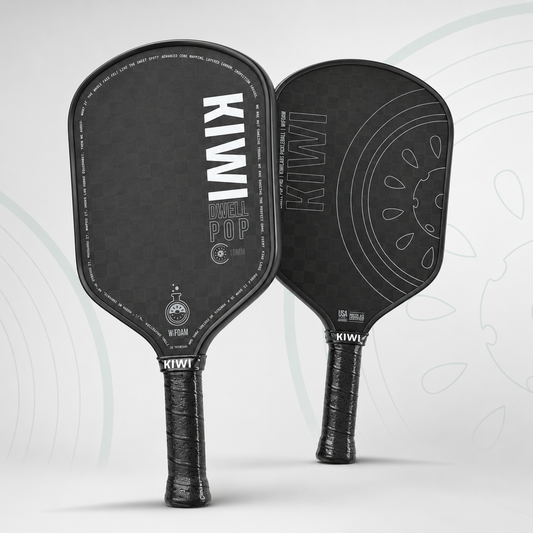
That is the value of matching paddle design to your game rather than buying the most expensive option with the loudest claims. Kiwi Labs Pickleball builds modern carbon fiber paddles around the real performance categories players feel every point: sweet spot, spin, control, and pop. The right fit supports better mechanics. It does not hide bad ones.
Make the Reset Your Reset Button
The reset is more than a defensive shot. It is a decision to slow the rally down and get back to a position where you can play on your terms. When pressure arrives, simplify: get balanced, show the paddle early, soften the grip, and send the ball to a generous kitchen target.
Practice that sequence until it feels boring. Then, when the pace gets fast and the ball comes at your shoelaces, you will have a response that keeps you in the point instead of handing it away.