


How to Test Paddle Control Before You Buy

A paddle can feel great during five warm-up swings and still betray you when a hard drive jams your body or a tight dink asks for millimeter-level touch. That is why knowing how to test paddle control matters more than casually bouncing a ball on the face. Real control is not a vague “soft feel.” It is the ability to send the ball where you intend, with predictable height, depth, and pace when the point gets fast.
For most players, the best control test happens on a court with your usual ball, not in a showroom or through a few hand taps. Bring the paddle into the shots that decide games: dinks, drops, resets, blocks, and directional drives. Then pay attention to the pattern of your misses. The paddle that gives you the biggest sweet spot, clearest feedback, and most repeatable launch is usually the control winner.
What Paddle Control Actually Means
Control is the paddle’s ability to help you manage the ball rather than merely absorb it. A controlled paddle lets you deaden a speed-up, place a third-shot drop into the kitchen, and roll a dink without sending it floating too high. It should respond consistently across the usable hitting surface, especially when contact drifts away from the center.
That does not mean control paddles have no power. It means their power is easier to regulate. A paddle with strong pop can still be controlled if it gives you enough dwell time and a predictable response. Dwell time is the brief moment the ball stays on the face. More usable dwell can make it easier to shape the ball, add spin, and take pace off a hard shot.
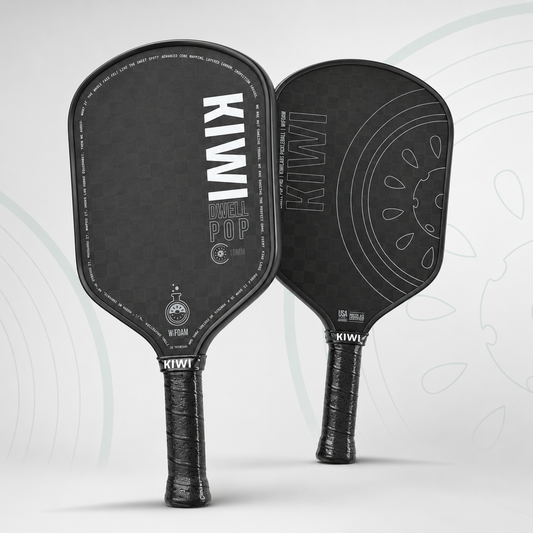
Construction affects this. Raw carbon faces can provide grip and connected feedback. Thicker cores often soften impact and improve stability, while thinner or highly reactive builds can produce faster hand speed and more pop. Full-foam and thermoformed designs can expand the sweet spot and add stability, but feel varies dramatically from one paddle to another. The spec sheet gives you clues. Your contact point gives you the answer.
How to Test Paddle Control on Court
Do not try to judge every quality at once. Start with a simple baseline: hit the same shot repeatedly, then notice whether the ball leaves the face at a consistent height and distance. A good test paddle should make your good mechanics more repeatable, not force you to baby every swing.
Start With Kitchen-Line Dinks
Begin with straight-ahead crosscourt dinks at a moderate pace. Your goal is not to win the exchange. Aim for a target about a foot inside the kitchen line and repeat the same shape of shot 15 to 20 times.
Ask whether the paddle lets you feel the ball sink into the face or whether it jumps unexpectedly. If your dinks keep landing deep despite a relaxed swing, the paddle may have more pop than your short game currently needs. If you have to push hard just to reach the opponent’s kitchen, it may be too muted for your stroke.
Next, test side-to-side placement. Hit three dinks crosscourt, then send one toward the opponent’s outside foot or back toward the middle. A controllable paddle should help you change direction without changing your entire swing. Notice off-center contact here. Kitchen exchanges expose a small or unstable sweet spot fast.
Test Third-Shot Drops From the Baseline
The third-shot drop is one of the clearest control tests because it requires touch, depth management, and a comfortable launch angle. Hit ten drops from behind the baseline, aiming to clear the net by roughly one to two feet and land in the kitchen.
Count outcomes, not just your best balls. How many drops land short? How many sail beyond the kitchen? How many feel like clean strikes but still launch unpredictably? If you can produce a reliable arc with a compact swing, the paddle is working with your game.
Try both a softer, high-arcing drop and a more driven drop. Some paddles excel when you brush slowly under the ball but become hot when you accelerate. Others feel stable on a firmer drop but lack the touch you want on a defensive, high-pressure ball. Neither is automatically wrong. It depends on whether you play a patient transition game or prefer to attack your way forward.
Put the Paddle Under Reset Pressure
Soft hands are useful. Soft hands under pressure are where paddle design earns its keep. Have a partner drive balls from the baseline or transition zone while you stand near the kitchen line and reset them into the non-volley zone.
Focus on a quiet grip and minimal backswing. The paddle should not twist heavily when the ball catches the edge of the face, and it should not turn a defensive block into an accidental attack. Stability matters here because the ball is arriving with pace. A larger, more forgiving sweet spot gives you more margin when a fast ball catches you late.
If every reset dies into the net, check your technique before blaming the paddle. But if centered blocks float while off-center blocks spray or wobble, you are likely feeling inconsistent face response. That is useful data, especially for players who spend a lot of time in fast hands battles.
Check Depth on Serves and Returns
Control is not only a kitchen-line quality. A paddle that helps you land a deep serve or return can keep opponents pinned back and buy your team time to establish the line.
Hit several serves at 70 to 80 percent effort, targeting the last third of the service box. Then hit returns with your normal compact stroke. You are looking for depth without having to swing recklessly. If the paddle feels too lively, your comfortable swing may send balls long. If it feels overly dampened, you may lose easy depth and start muscling the ball.
This is also the time to test spin. Hit a few topspin serves and rolling returns. A grippy carbon face can help you shape the ball, but the important question is whether you can control the resulting trajectory. More spin is valuable only when it helps the ball dip where you planned.
Separate Paddle Feedback From Player Adjustment
Every new paddle has an adjustment period. A different grip size, swing weight, balance point, or face texture can change timing. Do not reject a paddle after three mishits, but do not talk yourself into a bad fit after one highlight-reel winner either.
Give the paddle at least one focused session. Use the same ball, play against a similar level of opponent, and test it while fresh and again when your hands are tired. A paddle that feels controlled only during slow drilling may be too demanding in live play.
Pay special attention to swing weight. A head-heavy paddle can feel exceptionally stable on blocks and counters, yet slower during quick hand exchanges. A lighter paddle may be fast and maneuverable but less steady against heavy pace. Control is not one number. It is the balance between touch, stability, speed, and the way you personally create power.
A Simple Scorecard for Comparing Paddles
If you are testing two or more paddles, write down a quick score after each session. Memory is unreliable once several paddles start to feel similar. Rate each one from 1 to 5 for these five areas:
- Dink height and placement consistency
- Third-shot drop confidence
- Reset stability against hard drives
- Depth control on serves and returns
- Feedback and forgiveness on off-center contact
Control Should Feel Repeatable, Not Restrictive
The best paddle control does not make you feel like you are playing cautiously. It gives you permission to swing with intent because you trust where the ball will go. You should be able to soften a reset, roll a dink, drive through a return, and accelerate on a put-away without feeling like each shot requires a separate paddle.
That is the value of modern materials when they are used well: not inflated price tags or technical buzzwords, but a more forgiving sweet spot, useful spin, stable touch, and confidence when the ball comes fast. Test with purpose, trust repeated results over first impressions, and choose the paddle that makes your next ball easier to place.