
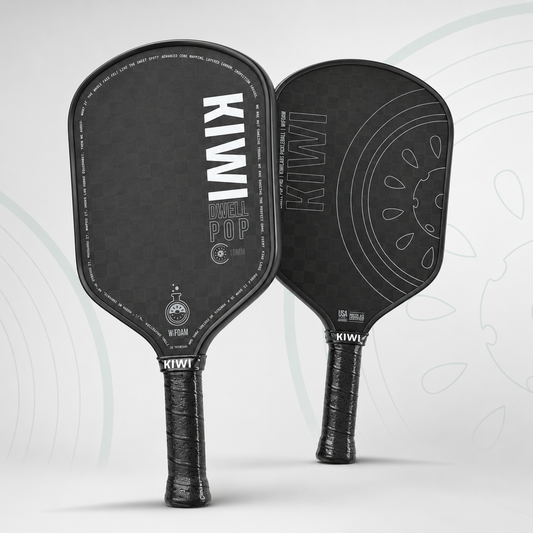


What Makes a Paddle Forgiving? 6 Key Traits

A forgiving paddle shows its value when the ball does not meet the center of the face. You are stretched wide for a backhand block, late on a hard drive, or trying to reset a speed-up at your feet. Instead of twisting, dying short, or launching off line, the paddle gives you a playable ball. That is the real answer to what makes a paddle forgiving: it protects your consistency when your contact is less than perfect.
For most players, forgiveness is not a soft, vague marketing term. It is a measurable performance trait tied to sweet spot size, stability, core construction, face response, and how the paddle is balanced. A forgiving paddle will not replace clean technique, but it can make a major difference in the shots that decide recreational and competitive games alike.
What Makes a Paddle Forgiving on Court?
A forgiving paddle is predictable across more of its hitting surface. The center of the paddle still produces the cleanest response, as it should. But when contact drifts toward the toe, heel, or upper edge, the paddle maintains more pace, direction, and feel than a less stable design.
That matters because pickleball is full of imperfect contacts. Kitchen exchanges happen fast. Resets are often defensive and off balance. Even strong players catch a ball near the edge when they are reaching, reacting, or disguising a shot. If your paddle punishes every small miss with harsh vibration or a ball that sails long, it asks more precision from you on every swing.
Forgiveness is especially valuable for players building confidence in soft-game shots. A larger, more stable response zone gives you a better chance of dropping a third, absorbing pace on a reset, or keeping a dink from floating too high. It also helps at the baseline, where an off-center serve return can otherwise give away depth and control.
1. A Larger, More Usable Sweet Spot
The sweet spot is the area where the paddle feels most solid and transfers energy most efficiently. On a forgiving paddle, that high-performing area is not limited to one tiny patch in the middle. It extends farther toward the edges, creating a larger usable hitting zone.
Sweet spot size is about more than raw power. A broad sweet spot helps the ball come off the face with consistent launch and pace. When you catch a drive slightly high on the face or block a speed-up closer to the toe, you are less likely to get a dead ball or an unexpected pop-up.
Paddle shape can influence this. Wider, standard-shaped paddles often have a naturally broad sweet spot, while elongated paddles can concentrate the sweet spot a little higher and narrower. That does not make elongated paddles unforgiving by default. Many use modern construction to add stability and expand their effective hitting area. But players who prioritize easy, confidence-building contact often appreciate the balanced response of a standard or hybrid shape.
2. High Twist Weight and Edge Stability
If a paddle twists in your hand when the ball hits near the edge, it will feel less forgiving. This is where twist weight matters. Twist weight describes how well the paddle resists rotating on off-center contact.
A paddle with solid edge stability stays more square through the ball. That means your block is more likely to travel where you aimed it, even when a hard hitter catches you late. It also reduces the harsh, unstable feeling that can travel into your wrist and elbow after mishits.
Perimeter weighting, foam around the edge, and well-designed thermoformed construction can all help increase stability. The goal is not simply to make a paddle heavy. Extra weight can improve stability, but too much of it can slow your hands at the kitchen and fatigue your arm over a long session. The best forgiving paddles find a useful balance: enough mass and perimeter support to resist twisting, without feeling like a club in fast hands battles.
3. A Core That Absorbs Pace Without Going Dead
Core construction has a huge effect on forgiveness. A paddle that is too stiff or overly explosive may feel great when you strike the exact center, but it can become jumpy on defensive shots or less predictable near the edges. A more controlled core helps absorb incoming pace and gives the ball a steadier response.
Thicker cores are commonly associated with control and touch because they can increase dwell time, the brief moment the ball stays on the face. More dwell time can make it easier to shape dinks, cushion blocks, and keep resets low. That does not mean every thick paddle is soft or every thin paddle is wild. Face material, layup, foam, and construction method all change the final feel.
Full-foam and foam-enhanced paddles have pushed this category forward. When engineered well, foam can support the perimeter, broaden the sweet spot, and create a more connected response across the face. The trade-off is feel. Some players love a plush, dampened impact, while others want clearer feedback and more pop. Forgiveness should feel stable, not numb.
4. Consistent Face Response From Center to Edge
A forgiving paddle does not surprise you. You should not need to make a different swing just because the ball lands an inch closer to the edge. Consistency across the face is what lets you trust your paddle under pressure.
Raw carbon fiber faces can contribute to that confidence by offering strong ball bite and controlled feedback. The texture helps players create spin, which is a form of practical forgiveness on its own. A topspin drive has more margin to dip inside the baseline. A sliced return can stay lower. A well-brushed dink can be shaped away from an opponent instead of sitting up in the middle.
Still, spin alone does not make a paddle forgiving. A highly textured face on an unstable paddle can still punish off-center contact. The strongest all-court designs pair a spin-friendly face with a stable structure and a core that does not overreact when the game speeds up.
5. The Right Weight and Balance for Your Swing
A paddle can have a huge sweet spot on paper and still feel unforgiving if its balance does not work for your game. Head-heavy paddles can add plow-through and power, but they may be harder to maneuver during rapid exchanges. If you are frequently late to the ball, the extra swing weight can create more off-center contact, not less.
A more balanced paddle tends to feel quicker in the hand. It can help players get the face in position for punch volleys, counters, and emergency blocks. Many developing players find this immediately useful because it improves their ability to meet the ball cleanly in the first place.
There is no universal best setup. A strong player who attacks from the baseline may welcome more head weight for drives and serves. A doubles player who lives at the kitchen may favor faster handling. Forgiveness is partly about the paddle's construction and partly about whether you can consistently put that construction in the right place.
6. A Feel That Encourages Confident Shots
The final piece is feel. A paddle should tell you enough about contact to help you improve, without punishing you for every minor miss. If the paddle vibrates sharply on routine blocks or sends soft shots unpredictably long, players often tighten their grip and start steering the ball. That usually makes the problem worse.
A forgiving paddle encourages a relaxed, repeatable swing. You can take a confident cut at a third-shot drop, absorb a drive with a soft hand, and trust that a near-center contact will still give you a reasonable result. That confidence compounds. Better decisions and freer swings lead to more consistent execution.
This is why forgiveness is valuable at every level. Beginners benefit because it shortens the learning curve. Intermediate players benefit because it supports the transition from safe shots to more aggressive patterns. Advanced players benefit because the fastest points are rarely played from perfect positions.
Forgiving Does Not Mean Low Performance
Some players hear “forgiving” and assume the paddle will be soft, underpowered, or built only for beginners. That is outdated. Modern paddle design can deliver a large sweet spot, serious spin, controlled touch, and enough pop to finish balls.
The trade-off is usually at the extremes. The most powerful, stiffest paddles may offer a hotter response on clean contact, while highly control-focused paddles may require more effort to generate put-away pace. A well-rounded, forgiving paddle aims for the performance most players can access most often, not just the occasional highlight-reel winner.
Kiwi Labs builds around that idea: premium materials and modern construction should create more playable shots, not just bigger claims on a spec sheet. When comparing paddles, look beyond a single number like weight or thickness. Pay attention to how sweet spot size, perimeter stability, core feel, spin, and balance work together.
The right forgiving paddle makes the hard balls a little less hard. It gives your reset a chance, keeps your block in play, and lets you swing with conviction when the point is moving too fast for perfect contact. That is the kind of performance that shows up long after the first few hits.