


Low Swingweight Pickleball Paddle Guide

If your hands feel late at the kitchen even when your reads are right, the issue might not be your reflexes. It might be your paddle. A low swingweight pickleball paddle can make the face feel quicker through hand battles, faster on counters, and easier to reset when points speed up.
That sounds like an automatic upgrade, but swingweight is one of the most misunderstood specs in pickleball. Players hear “faster paddle” and assume better across the board. That is not how it works. Lower swingweight can absolutely improve maneuverability, but it can also change stability, plow-through, and the way the paddle carries power through contact. The right fit depends on how you win points.
What a low swingweight pickleball paddle actually means
Swingweight is not the same as static weight. Two paddles can both weigh 8.0 ounces and feel completely different in motion. Static weight tells you how heavy the paddle is on a scale. Swingweight tells you how heavy it feels when you move it.
That difference comes down to mass distribution. When more weight sits farther from your hand, the paddle feels slower to start and stop. When weight is pulled closer to the handle, the paddle moves faster. That is why some elongated paddles feel more demanding in fast exchanges, while some wider-body or more balanced builds feel easier to whip into position.
For most players, low swingweight shows up in a few obvious ways. Your hand speed improves. Flicks and counters require less effort. Quick blocks feel more natural because the paddle face gets where it needs to go sooner. On defensive resets, especially when you are stretched or jammed, the paddle can feel easier to control.
Why players chase lower swingweight
The kitchen line is where swingweight becomes real. In slow drilling, almost any paddle can feel manageable. In live points, with balls ricocheting off drives and counters, small differences in maneuverability become huge.
A lower swingweight paddle helps when you rely on fast hands, compact strokes, and quick face adjustments. If you like to speed up from the kitchen, counter off your body, or absorb pace with short resets, a quicker paddle gives you more margin. It can also reduce fatigue over long sessions because you are not fighting the paddle on every exchange.
This matters even more for players who do not have perfect timing yet. Intermediate players often benefit from lower swingweight because it helps them react instead of muscling the paddle through contact. You do not need elite mechanics to feel the difference. If a paddle consistently feels late, clunky, or hard to recover with, swingweight is worth looking at.
The trade-offs most reviews gloss over
Here is the part that gets skipped too often: lower swingweight is not free performance.
When a paddle gets easier to move, it can also become easier to knock around on contact. Against hard hitters, a very low swingweight build may feel less stable unless the paddle design compensates with strong twistweight, foam reinforcement, or a forgiving face construction. That is why “fast” and “solid” do not always travel together.
You may also notice less plow-through. Heavier-swinging paddles tend to carry more momentum through the ball, which can help on drives, serves, and putaways. A lower swingweight paddle can still produce power, especially with thermoforming or lively core construction, but the feel is different. Instead of the paddle doing more of the work through mass, you may need more acceleration from your swing.
Touch can shift too. Some players love the lighter, quicker response. Others feel like the paddle gets almost too twitchy, especially on dinks or transition resets, where they prefer a little more mass to steady the face. This is why a paddle that feels amazing in hand battles might not feel as confident from the baseline.
Who should consider a low swingweight pickleball paddle
If you are a hands-first player, this category makes a lot of sense. Think about the player who wins at the kitchen with reaction speed, sharp counters, and compact attacks. That player usually benefits from a fast, maneuverable setup.
It also suits players coming from tennis who are used to generating their own pace and want a paddle that gets out of the way quickly. Instead of leaning on raw mass for power, they often prefer something they can accelerate on demand.
A lower swingweight option can also be smart for players dealing with arm fatigue. That does not mean every low swingweight paddle is automatically arm-friendly, because stiffness and handle feel still matter, but less resistance in motion can reduce effort over time.
Beginners and improving intermediates can benefit as well, especially if they struggle in firefights. A paddle that feels easier to position can make the learning curve less punishing. You still need sound technique, but you are not battling sluggishness while trying to develop it.
Who might want something more balanced
Not every player should chase the lowest number possible. If your game is built around heavy drives, deep serves, and full swings from the baseline, too little swingweight can leave you wanting more substance through contact.
The same goes for players who value stability above all else. If you often block back hard pace and want the paddle face to stay planted, a slightly higher or more middle-of-the-road swingweight may feel better. This is especially true if you play against bigger hitters and do not want the paddle head to flutter on off-center contact.
Control players sometimes assume lower swingweight is automatically better because it feels easier to move. Sometimes that is true. Other times, a little more mass actually improves touch because the paddle settles the ball instead of reacting too sharply. Feel is personal, and this is where specs need context.
What to look for besides swingweight
Swingweight matters, but it should never be read alone. A paddle is a system, not a single number.
Shape is a big factor. Elongated paddles often swing heavier because more mass sits away from the hand. Wider shapes can feel faster and more forgiving, though that is not universal. Handle length also affects where weight sits and how the paddle balances in motion.
Construction matters just as much. Raw carbon faces, thermoformed edges, foam walls, and core thickness all influence how a paddle feels when you swing and when you make contact. You can have two paddles with similar swingweights that play very differently because one is more stable, more powerful, or more muted.
Twistweight is another spec worth paying attention to if you can find it. A low swingweight paddle with decent twistweight can give you the quickness you want without feeling flimsy on off-center hits. That blend is where a lot of advanced all-court performance lives.
How to tell if your current paddle is too high in swingweight
You do not need a lab to get a useful answer. Your body usually tells you.
If kitchen exchanges feel rushed even when your anticipation is solid, if counters keep arriving late, or if your paddle feels slow to recover after each volley, your current setup may be asking too much from your hand speed. The same applies if your resets improve in drills but break down in games when pace rises.
Another clue is how the paddle feels over a full session. If your forearm or shoulder gets tired from what should be compact exchanges, the issue may not be total weight. It may be how that weight is distributed.
On the other hand, if your drives feel heavy and confident, your blocks stay stable, and only your reaction speed needs work, technique may be the bigger factor. Equipment can help, but it does not replace cleaner preparation.
Finding the sweet spot between speed and substance
The smartest move is usually not “get the lightest-swinging paddle possible.” It is finding the lowest swingweight that still gives you enough stability, power, and touch for your style.
That is where modern paddle design gets interesting. Some of the best-performing paddles now aim for faster handling without giving up too much solidity. Better layups, foam-enhanced constructions, and more intentional balance points help brands create paddles that feel quick but still hold up in hard exchanges. That is the real target, not just a number that looks good on paper.
For many players, the ideal setup is an all-court paddle that leans quick rather than extreme. Fast enough to win hand battles, stable enough to block pace, and controlled enough to reset under pressure. That middle ground is often more useful than a paddle built around one flashy spec.
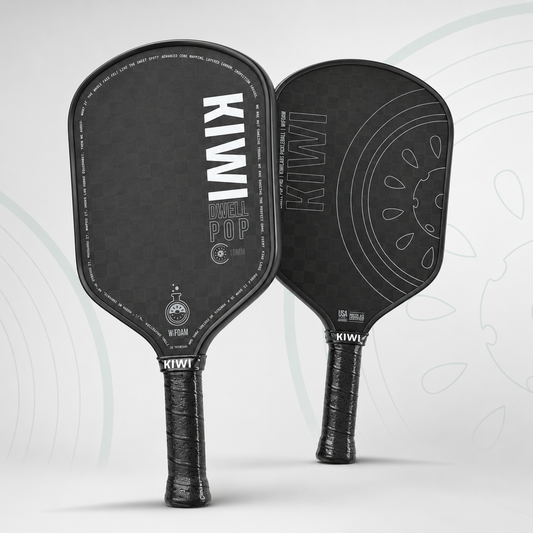
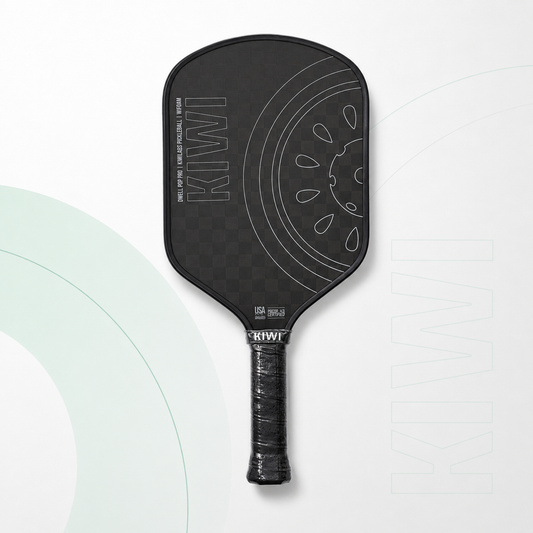
Kiwi Labs has leaned into that same idea with modern carbon fiber paddle designs that prioritize real performance traits like spin, sweet spot size, pop, and control instead of hiding behind inflated pricing and vague marketing language.
If you are considering a low swingweight pickleball paddle, start with your actual pain point. Do you need faster hands, easier resets, and less drag through quick exchanges? Or do you really need more stability and putaway power? The best paddle choice is the one that solves the problem you feel in real points, not the one attached to the loudest spec sheet.
A paddle should make your game feel clearer, not more complicated.